🐱 Encyclopedia of American Bobtail Cat (Felis catus)
Comprehensive breed encyclopedia: American Bobtail cat natural bobbed tail mutation, 1960s Arizona origin legend, CFA/TICA full championship recognition, shaggy coat, dog-like personality, therapy cat excellence, and complete health and care documentation
✏️ Written by the Encyclopedia.guru Expert Writing Team | Last Updated: March 24, 2026 | Reviewed by Certified Feline Specialists

The American Bobtail is a naturally occurring domestic cat breed originating in the United States, distinguished by its short, naturally bobbed tail — the result of a spontaneous dominant genetic mutation. Unlike most bobtail breeds developed in Asia, the American Bobtail was developed exclusively from American domestic cat populations beginning in the 1960s, when a kitten named Yodi — found on a reservation in Arizona — was crossed with a domestic female cat, producing kittens that also displayed the characteristic short tail. This confirmed the dominant hereditary nature of the bobtail gene in the American cat population.
The American Bobtail is recognized today by both the Cat Fanciers’ Association (CFA) and The International Cat Association (TICA), holding full championship status in both major international cat registries. The breed is known for its remarkable dog-like temperament — extraordinarily loyal, interactive, and trainable — making it one of the most popular choices for therapy animal programs in the United States. It comes in both shorthair and semi-longhair varieties, both with the characteristic shaggy, weather-resistant coat and powerful, athletic build. The tail itself is always present (unlike some Manx cats) but significantly shorter than normal, variable in length, and may curve, be straight, or have slight kinks.
- Natural bobbed tail — dominant gene: The American Bobtail’s shortened tail results from a naturally occurring dominant gene mutation, not human manipulation; one copy of the gene is sufficient to produce a short tail; it differs genetically from both the Japanese Bobtail (recessive gene) and the Manx (different gene producing taillessness).
- Dog-like personality: Among the most dog-like of all cat breeds; follows owners from room to room; learns to fetch, play games, and walk on a leash; responds to its name; adapts to strangers and other pets exceptionally well; often used as a therapy animal.
- Slow maturity: American Bobtails are exceptionally slow to mature physically, reaching full adult size at 2–3 years; this is longer than most domestic cat breeds and owners should not mistake the continuing growth for unusual development.
- Wild appearance, gentle nature: The American Bobtail has a wild, lynx-like appearance — shaggy coat, broad head, deep-set eyes, and prominent brow — but is fundamentally a gentle, affectionate companion breed with none of the temperamental challenges of wildcat hybrids.
- Two coat varieties: CFA recognizes both shorthair and longhair (semi-longhair) varieties; both have the characteristic shaggy, weather-resistant texture with tufted paws and ears; the longhair has a ruff around the neck and tail plume; both shed moderately.
- Tail diversity: Every American Bobtail has a unique tail; length varies from 1 to 4 inches and may be straight, curved, kinked, or bumpy; the tail should ideally reach the hock when let down; breed standard accepts all tail forms as long as the overall length qualifies as a bobtail.
The American Bobtail occupies a unique position in the domestic cat world: it combines the visual drama of a wild cat — a shaggy, muscular body, tufted ears, and the distinctive bobbed tail reminiscent of the bobcat from which the breed was once (incorrectly) believed to descend — with one of the most accommodating, human-focused temperaments in the entire cat fancy. This paradox of wild appearance and gentle nature has made the American Bobtail a steadily growing favorite among cat enthusiasts in North America and increasingly around the world.

CC BY-SA 3.0 • 335×304 px (19.5 KB) • Author: Klarissae • Natural bobtail domestic cat, 1996
CC BY-SA 3.0 • 3,264×2,448 px (2.77 MB) • Author: Lin Rongxiang • 29 Oct 2018
Why the American Bobtail Stands Apart
- Genuine American origin: Unlike most recognized pedigree cat breeds which originated in Europe or Asia, the American Bobtail is authentically and exclusively American in origin; it was developed entirely from domestic cat populations found in the United States, without crossing to any wild species despite its wild-cat appearance.
- Therapy and travel companion: The breed has earned a reputation as an outstanding therapy cat and travel companion; it is notably popular among long-haul truck drivers in the USA; its calm adaptability to confined spaces, high human-bonding instinct, and road-travel tolerance make it uniquely suited to mobile lifestyles.
- Wild appearance vs. gentle nature: Many potential owners are attracted by the American Bobtail’s resemblance to a wild bobcat (Lynx rufus), but it should be clearly understood that the American Bobtail is 100% domestic Felis catus; its wild appearance is the product of selective breeding for a natural, athletic look, not any wildcat ancestry.
Systematic Classification
| Taxonomic Rank | Classification |
|---|---|
| Kingdom | Animalia |
| Phylum | Chordata |
| Class | Mammalia |
| Order | Carnivora |
| Family | Felidae |
| Genus | Felis |
| Species | F. catus |
| Breed | American Bobtail |
| Coat varieties | Shorthair; Longhair (semi-longhair) |
| CFA Group | Shorthair / Longhair (separate classes) |
| Origin country | United States of America |
| Breed development | 1960s – present; CFA recognition 2000/2006 |
| NOT related to | Bobcat (Lynx rufus); Japanese Bobtail; Kurilian Bobtail; Manx |
Genetic Classification of the Bobtail Mutation
- American Bobtail gene: Dominant autosomal mutation; one copy sufficient to produce bobbed tail; cats can be heterozygous (one copy, Bb) or homozygous (two copies, BB); homozygous BB cats may have health issues; heterozygous Bb is standard for healthy breeding.
- Distinct from other bobtails: The American Bobtail mutation is genetically unrelated to the Japanese Bobtail (which is caused by a different recessive gene) and the Manx (caused by yet another gene that can produce taillessness and spinal problems); the Kurilian Bobtail also carries a distinct gene.
- No bobcat ancestry: Early breed folklore claimed the American Bobtail descended from a domestic female bred with a wild bobcat (Lynx rufus); this has been definitively disproven by genetic analysis; domestic cats and bobcats cannot produce fertile offspring due to chromosomal incompatibility; the short tail is purely a domestic cat mutation.

CC BY-SA 3.0 • 2,048×1,536 px (1.41 MB) • Author: Dushka

CC BY-SA 3.0 • 660×830 px (57 KB) • Source: catza.net • 7 Jan 2015
CFA Breed Standard Summary
| Feature | Standard Description |
|---|---|
| Body | Medium to large; rectangular; muscular; broad chest; substantial bone; full-fleshed flanks; athletic appearance; neither cobby nor rangy |
| Head | Broad, modified wedge; distinctive brow ridge creating a “hunting gaze”; prominent whisker pads; slightly concave curve to nose in profile |
| Ears | Medium-large; wide-set; slightly tilted forward; tufts desirable; lynx-tipping acceptable |
| Eyes | Large; almond-shaped; deep-set; slightly oblique; all colors accepted; the brow gives an alert, “hunting” expression |
| Legs & Feet | Legs medium-long; hind legs slightly longer than forelegs; feet round and large; tufts desirable |
| Tail | Bobbed; visible above back when alert; length variable (1–4 in / 2.5–10 cm); may be straight, curved, bumpy, or kinked; all are equally acceptable; must be present (not tailless) |
| Coat (shorthair) | Medium-length; shaggy; weather-resistant; not close-lying; double coat; slightly hard outer coat |
| Coat (longhair) | Semi-long; shaggy; full ruff around neck; tail plume; britches; tufted paws; not silky |
| Colors & patterns | All colors, patterns, and combinations accepted; no color or pattern preference in judging |
| Weight | 7–16 lbs (3.2–7.3 kg); male significantly larger than female; substantial and heavy for size |
CC BY-SA 3.0 • 3,264×2,448 px • Author: Lin Rongxiang
CC BY-SA 3.0 • 335×304 px • Author: Klarissae • Natural bobtail domestic cat
Genetics of the Bobtail Tail
- Dominant gene: The bobtail mutation in the American Bobtail is a dominant autosomal mutation; a cat with just one copy of the gene (heterozygous, Bb) will have a shortened tail; this contrasts with the Japanese Bobtail, where the gene is recessive (requiring two copies).
- Tail length variability: Even within the same litter, tail length and shape are highly variable; no two American Bobtails have identical tails; the tail may be straight, curved, kinked, bumpy, or even have multiple segments; this variability is considered a feature rather than a flaw.
- Ideal length: The breed standard specifies that the tail should be long enough to be visible above the back when the cat is alert, but not so long that it resembles a normal tail; the ideal is approximately 1 to 4 inches (2.5 to 10 cm).
- Must be present: Unlike the Manx, where taillessness is common and acceptable, the American Bobtail must have a visible tail; completely tailless American Bobtails are not shown in competition.
- Homozygous risk: Cats with two copies of the bobtail gene (BB, homozygous) may have spinal abnormalities; responsible breeders breed heterozygous Bb × normal-tailed (bb) cats; this reduces the chance of homozygous offspring while maintaining the bobtail trait in the litter.

CC BY-SA 3.0 • 952×822 px (79 KB) • Source: catza.net

CC BY-SA 4.0 • 3,761×3,456 px (599 KB) • Author: TRUE KURILIANS

CC BY-SA 4.0 • 5,184×3,456 px (704 KB) • Author: TRUE KURILIANS
American Bobtail Coat Standards
| Coat Feature | Shorthair | Longhair (Semi-longhair) |
|---|---|---|
| Texture | Shaggy; slightly hard outer coat; not close-lying; weather-resistant | Shaggy; semi-long; not silky; weather-resistant |
| Undercoat | Double coat with moderate undercoat | Double coat; slightly more substantial undercoat |
| Length distribution | Medium length on body; shorter on face and legs | Full ruff around neck; britches on hind legs; tail plume; tufted paws and ears |
| Colors accepted | All colors, all patterns, all combinations — no color preference in judging; tabby, solid, pointed, particolor all equally accepted | |
| Grooming frequency | 1–2 times per week | 2–3 times per week; more during seasonal sheds |
| Matting tendency | Low | Moderate; less than most true longhair breeds |
CC BY-SA 3.0 • 335×304 px • Naturally bobtailed domestic cat, natural mutation
CC BY-SA 3.0 • 3,264×2,448 px • Contemporary American bobtail type, 2018
Origin Story: Yodi of Arizona
The American Bobtail breed origin story centers on a kitten named Yodi, discovered by John and Brenda Sanders on a reservation near Tucson, Arizona, in the late 1960s. Yodi had a naturally short, bobbed tail and was brought home by the Sanders family. When Yodi bred with the Sanders’ female domestic cat named Mishi (a color-pointed female), their kittens also had short tails — demonstrating to the Sanders and later to geneticists that the bobtail mutation was dominant and heritable.
Breed Development Timeline
| Period | Key Development |
|---|---|
| Late 1960s | Yodi discovered in Arizona; crossed with Mishi; first American Bobtail kittens born; dominant bobtail gene confirmed; breed development begins |
| 1970s | Initial breeding program; early breed standards developed; breed initially carried unhealthy genetics including too much inbreeding; health-related setbacks |
| 1980s | Breed reformulated by breeders including Charlotte Bentley and Mindy Schultz; wild-looking, non-pedigreed domestic cats with bobtails incorporated to broaden genetic base; modern American Bobtail type established |
| 1989 | TICA (The International Cat Association) accepts American Bobtail for registration |
| 2000 | CFA (Cat Fanciers’ Association) grants championship status to American Bobtail Shorthair |
| 2006 | CFA grants championship status to American Bobtail Longhair |
| 2000s–present | Breed grows in popularity in USA; remains relatively rare; limited international presence; therapy cat role established; truck driver companion culture noted |
Early Breed Health Issues & Correction
The original American Bobtail program in the 1970s was hampered by excessive inbreeding within a small founder population, resulting in genetic health problems including skeletal abnormalities. Breeders in the 1980s corrected this by introducing healthy, naturally bobtailed domestic cats of non-pedigree background to broaden the gene pool, dramatically improving the breed’s overall health and the naturalness of its appearance. The modern American Bobtail is a distinctly different — and healthier — animal than the early 1970s version of the breed.
Recognition Status (2026)
| Registry | Status | Notes |
|---|---|---|
| CFA (Cat Fanciers’ Assoc.) | Full Championship | Shorthair: 2000; Longhair: 2006; shown in separate classes; both eligible for Grand Champion and Regional/National awards |
| TICA (The International Cat Assoc.) | Full Championship | Registration since 1989; championship competition; globally exhibited at TICA-sanctioned shows |
| ACFA (American Cat Fanciers Assoc.) | Recognized | Full championship recognition |
| UFO (United Feline Organization) | Recognized | Championship status |
| WCF (World Cat Federation) | Limited recognition | Less common outside North America in WCF circuit |
| FIFe (Fédération Int’l Féline) | Not recognized (2026) | Limited European/international breeding population |
| GCCF (UK) | Not recognized (2026) | Very rare in UK |
Show Competition
- CFA show classes: American Bobtail Shorthair and American Bobtail Longhair are shown in separate championship classes; competition is open to altered (neutered/spayed) and intact cats; all colors and patterns compete in one color class (AOV for pointed colors in some registries).
- Judging emphasis: Judges evaluate the distinctive bobtail (visible above back when alert), wild appearance, muscular body type, and the shaggy weather-resistant coat; color and pattern are equal and not ranked over each other.
- Rarity at shows: Despite CFA/TICA recognition, the American Bobtail remains relatively rare at cat shows compared to more popular breeds; its limited breeding population means fewer entries at most shows.
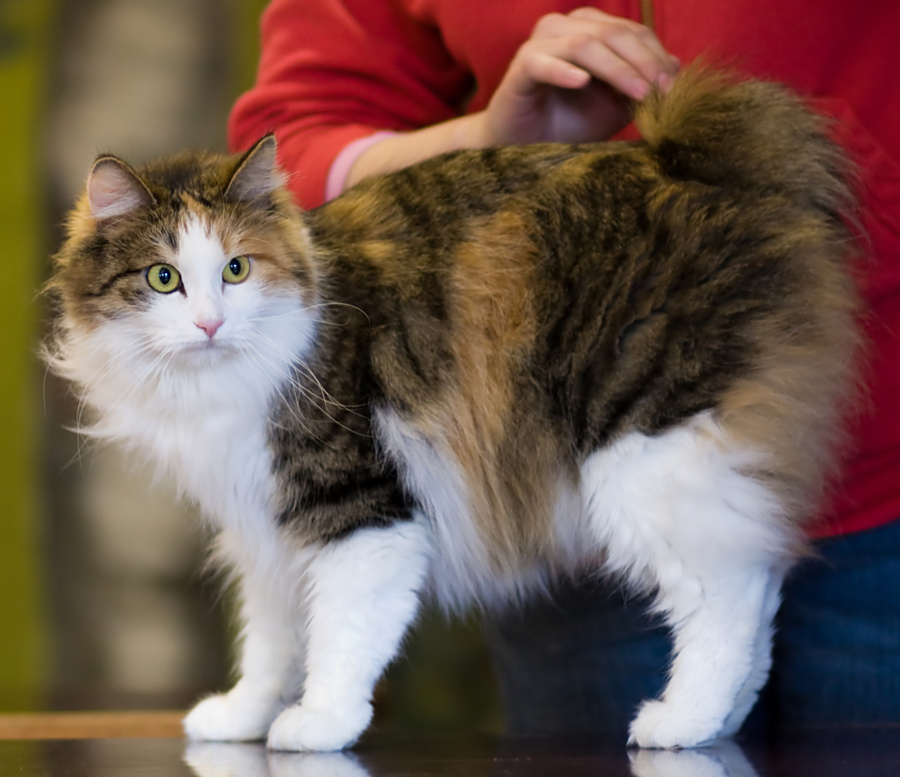
CC 1.0 Public Domain • 900×777 px (226 KB) • Author: Dushka • 2008 cat show

CC 1.0 Public Domain • 708×525 px (101 KB) • Author: Dushka
Core Behavioral Traits
- Dog-like loyalty: American Bobtails are famous for following their owners from room to room; they greet owners at the door, watch household activities with intense interest, and prefer to be where the action is; this behavior pattern is consistently compared to dogs more than typical cats.
- Interactive play: Many American Bobtails will learn to play fetch, carry toys to owners for a game, and respond consistently to their names; they initiate games and engage interactively rather than waiting to be entertained.
- Leash acceptance: With early training, the American Bobtail adapts exceptionally well to harness and leash walking; this is unusual in domestic cats and reflects the breed’s high trainability and interest in outdoor environments.
- Calm adaptability: Unlike many intelligent, active breeds that become destructive when bored, American Bobtails have a notably calm core temperament that allows them to adapt to varied living situations — from active family households to quiet single-person homes; they match the energy level of their environment.
- Travel tolerance: The American Bobtail is uniquely calm in vehicles compared to most cats; this trait has led to their popularity as long-haul trucker companions in the United States; they adapt to confined mobile living with apparent ease.
- Emotional sensitivity: American Bobtails are noted for their ability to sense emotional distress in humans; they respond to upset owners with increased attention and physical comfort; this emotional intelligence underpins their effectiveness as therapy animals.
Temperament Profile Table
| Trait | Level | Notes |
|---|---|---|
| Activity level | Moderate-High | Playful but calm; adapts to owner’s pace |
| Loyalty to family | Extremely High | Dog-like bonding; follows owners; deeply attached |
| Trainability | Very High | Fetches; leash walks; learns tricks; responds to name |
| Affection with family | Very High | Deeply affectionate; emotional sensitivity to owners |
| Kid-friendly | Very High | Patient, tolerant, and playful with children |
| Dog-friendly | Very High | One of the most dog-compatible cat breeds |
| Travel tolerance | Very High (unique) | Unusually calm in cars and RVs; trucker companion |
| Vocalization | Low-Moderate | Chirps, trills, and soft vocalizations; not loud |
| Therapy suitability | Excellent | Used in psychiatric and hospital therapy programs |

CC BY-SA 2.0 • 3,776×2,600 px (5.56 MB) • Author: Nickolas Titkov • 2009 Moscow cat show

CC BY-SA 2.0 • 3,800×2,500 px (5.09 MB) • Author: Nickolas Titkov • 2009 Moscow cat show
The Therapy Cat Role
The American Bobtail has been specifically noted by animal-assisted therapy practitioners as one of the most effective cat breeds for therapeutic work. Its combination of emotional sensitivity, tolerance of handling, social confidence, and non-reactive calmness makes it suitable for therapy settings where other cat breeds would be stressed or dangerous.
- Psychiatric therapy: American Bobtails have been used in psychiatric treatment facilities as calming presences for patients with PTSD, depression, anxiety disorders, and other mental health conditions; their ability to seek out distressed individuals and respond with physical comfort is especially valued.
- Hospital visits: Their tolerance of handling, calm in unusual environments, and non-reactive response to medical equipment and procedures make them suitable hospital therapy cats.
- Trucker companion culture: Uniquely among pedigree breeds, the American Bobtail has a documented subculture as a long-haul trucking companion in the United States; their calm acceptance of vehicle travel, small-space living, and road life with a single owner mirrors the breed’s therapy cat qualities in a mobile context.
- Key therapy traits: Emotional attunement to human distress; tolerance of strangers; low reactivity to noise; comfort with handling; willingness to initiate physical contact; stable temperament across environments.

CC BY-SA 2.0 • 3,677×2,500 px • Young bobtail kitten development

CC BY-SA 2.0 • 3,776×2,500 px • Bobtail kitten physical development

CC BY-SA 2.0 • 3,771×2,500 px • Bobtail kitten socialization behavior
Developmental Stages
- Birth: American Bobtail kittens are born with their bobtail length and shape already apparent; no two kittens have the same tail; tails do not grow longer after birth; kittens with very short or nearly absent tails at birth may be homozygous (BB) and require veterinary evaluation for spinal health.
- 0–4 weeks: Vigorous, stocky kittens; eyes open 7–14 days; the American Bobtail’s large, strong build is evident early; early socialization with humans is critical during this period for developing the breed’s characteristically confident, people-oriented temperament.
- 4–12 weeks: Critical socialization window; American Bobtail kittens should be exposed to varied people, children, dogs, sounds, and environments; this produces the adaptable, travel-tolerant adult that the breed is known for; kittens show early interactive play behavior and fetch tendencies.
- 3–12 months: Rapid growth; coat type and adult color pattern becomes apparent; shaggy texture develops; bobtail kittens grow slowly relative to domestic average; they should not appear undersized — they are simply slow-maturing.
- 12 months to 2–3 years: American Bobtails continue to fill out physically for 2–3 full years; buyers should not expect to see full adult size until age 3; the shaggy coat reaches full adult length and texture in the second year; full temperament character is established by 18–24 months.

CC BY 2.0 • 283×250 px (27 KB) • Author: Toby Woodwark • 1 May 2003
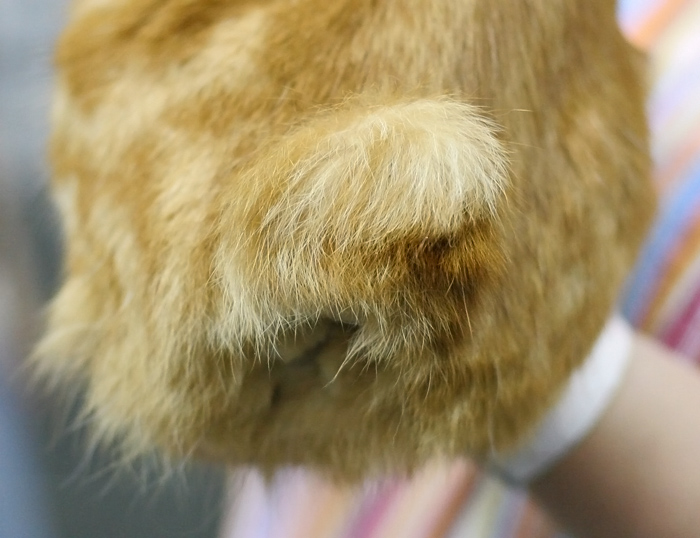
CC 1.0 Public Domain • 700×538 px (164 KB) • Champion female Kurilian Bobtail

Public Domain • 490×402 px (272 KB) • Russia Postal Stamp No.2612, 2020
Bobtail Cat Breeds Worldwide
| Breed | Origin | Tail Gene | Body Type | Recognition |
|---|---|---|---|---|
| American Bobtail | USA (1960s) | Dominant (Bb) | Medium-large; muscular; shaggy | CFA, TICA |
| Japanese Bobtail | Japan (ancient) | Recessive (bb) | Medium; elegant; pom-pom tail | CFA, TICA, WCF |
| Kurilian Bobtail | Kuril Islands, Russia | Dominant (distinct locus) | Heavy, muscular; semi-longhair | WCF, FIFe, TICA |
| Pixie-Bob | USA (1980s) | Polydactyl + bobtail | Large; wild-looking; bobcat-like | TICA |
| Manx | Isle of Man, UK | Dominant (tailless gene) | Round; cobby; rumpy to longy | CFA, TICA, GCCF |
| Mekong Bobtail | Southeast Asia | Distinct gene | Medium; elegant; Oriental type | WCF, FIFe |
Health Status Overview
The modern American Bobtail is considered a generally healthy breed, particularly after the genetic base was broadened in the 1980s. However, the bobtail gene itself carries some health considerations that responsible breeders and owners must understand.
| Health Consideration | Risk Level | Notes |
|---|---|---|
| Bobtail gene (BB homozygous) | Moderate (if homozygous) | Two copies of bobtail gene (BB) may cause spinal issues; responsible breeding avoids Bb × Bb matings |
| Spinal abnormalities | Low-Moderate | Risk primarily in homozygous individuals; completely tailless American Bobtails are not bred to standard |
| Obesity | Moderate | The stocky, muscular build predisposes to easy weight gain; diet management important |
| HCM (hypertrophic cardiomyopathy) | Standard feline | No breed-specific predisposition confirmed; standard cardiac screening recommended |
| General feline diseases | Standard | FIV, FeLV, herpesvirus, panleukopenia, calicivirus; standard vaccination and prevention protocol |
| Dental disease | Standard | Regular dental care; no breed predisposition beyond typical domestic cats |
| Lifespan | — | 13–15+ years; well-bred individuals may reach late teens |

CC BY-SA 2.0 • 3,577×2,500 px (4.4 MB) • Healthy bobtail kitten from managed program

CC BY-SA 2.0 • 3,800×2,600 px (5.22 MB) • Author: Nickolas Titkov • 2009 Moscow
Responsible Breeding Guidelines
- Bobtailed × normal-tailed: The most important breeding rule: always mate a bobtailed cat (Bb) with a normal-tailed cat (bb); expected outcome: 50% bobtail (Bb), 50% normal-tail (bb); eliminates risk of homozygous BB offspring with health issues.
- Genetic diversity: The breed was nearly lost to inbreeding in the 1970s; modern breeders are encouraged to maintain broad genetic diversity by incorporating healthy domestic cats of appropriate type when needed; the CFA breed standard allows for some outcrossing to domestic short/longhairs when approved.
- Tail evaluation at birth: Kittens should be evaluated at birth for tail length and spine health; kittens with very short or absent tails should be assessed by a veterinarian for spinal abnormalities; affected kittens may require specialized care or placement as non-breeding pets.
- Wild appearance, domestic health: Selection for the wild, athletic appearance should never compromise health; the broad, muscular build and shaggy coat should develop naturally without exaggeration.
- Slow maturity management: Breeding should not begin until full physical maturity (minimum 2 years for the American Bobtail); breeding too young can compromise both the queen’s health and the development of offspring.
Environment & Activity
- Active enrichment: The American Bobtail needs regular interactive play (20–30 minutes daily minimum); fetch games, wand toys, puzzle feeders, and interactive electronic toys satisfy the breed’s high intelligence and hunting drive; without enrichment, the breed may become bored and develop mild destructive behavior.
- Leash walking: Many American Bobtails benefit greatly from supervised outdoor exploration on a harness and leash; begin leash training as a kitten for best results; provides physical and mental stimulation beyond indoor-only environments.
- Indoor vs. outdoor: Best kept indoors or in secure outdoor spaces; despite their wild appearance and athletic ability, outdoor cats face risks from vehicles, predators, and disease; the American Bobtail’s high human-bonding instinct means it is also happiest in close proximity to its family.
- Companionship: Adapts well to multi-pet households; generally excellent with other cats, dogs, and children; can tolerate moderate alone time but benefits from companionship; not suitable for isolation in a single-pet household where owners are absent for very long hours.
Grooming & Nutrition
- Shorthair grooming: Brush 1–2 times per week with a slicker or medium-bristle brush; shaggy shorthair coat does not mat easily; seasonal spring and autumn shedding requires more frequent brushing.
- Longhair grooming: Brush 2–3 times per week; the semi-longhair shaggy coat is less prone to tangling than silk-coated longhairs, but the ruff, britches, and tail plume benefit from regular attention; a stainless steel comb helps remove loose undercoat.
- Diet: High-quality protein-rich diet appropriate to age and activity level; monitor weight carefully as the muscular American Bobtail can easily become obese with free-feeding and sedentary lifestyle; wet food for hydration; avoid high-carbohydrate diets.
- Dental care: Daily tooth brushing ideal; dental treats as supplement; regular professional dental cleanings as recommended by veterinarian; no breed-specific dental predisposition but general feline dental disease is common.
- Veterinary care: Annual wellness examinations; FVRCP and rabies vaccinations; FIV/FeLV testing; parasite prevention; annual cardiac screening (heart auscultation); no breed-specific blood panels required beyond standard feline care.
1. What is the American Bobtail cat?
The American Bobtail is a naturally occurring domestic cat breed from the United States, defined by its short, naturally bobbed tail (dominant genetic mutation), powerful athletic body, shaggy coat (short or semi-long), and exceptional dog-like, therapy-suitable temperament. Recognized by CFA and TICA.
2. Where does the American Bobtail come from?
Origin story: a bobtailed kitten named Yodi found in Arizona in the late 1960s was crossed with a domestic female; their kittens also had short tails; formal breeding programs developed over subsequent decades; CFA championship recognition achieved in 2000 (shorthair) and 2006 (longhair).
3. What does the American Bobtail look like?
A medium-to-large, muscular cat with a shaggy coat (all colors/patterns), a broad head with a “hunting gaze,” large deep-set eyes, tufted ears, and the defining naturally bobbed tail (1–4 inches, always present, never absent). Male: 12–16 lbs; female: 7–11 lbs. Wild-cat appearance with gentle nature.
4. Is the American Bobtail recognized by major cat registries?
Yes. CFA full championship: shorthair 2000, longhair 2006. TICA full championship. Also ACFA and UFO. FIFe and GCCF do not yet recognize the breed (2026).
5. What is the temperament of the American Bobtail?
Exceptionally dog-like: loyal, interactive, trainable; follows owners from room to room; fetches; walks on leash; excellent with children and dogs; adaptable to travel; used as therapy cats in psychiatric facilities; emotionally sensitive to human distress.
6. Is the American Bobtail healthy?
Generally healthy. Main concern: homozygous BB bobtail gene may cause spinal issues — responsible breeders prevent this by mating Bb (bobtail) × bb (normal tail). No other breed-specific hereditary diseases confirmed. Lifespan: 13–15+ years.
7. How big do American Bobtail cats get?
Medium to large: males 12–16 lbs (5.4–7.3 kg), females 7–11 lbs (3.2–5 kg). Stocky and muscular. Fully mature at 2–3 years — slower than most domestic breeds.
8. Are American Bobtails rare?
Yes — relatively rare even in the USA due to careful breeding requirements and limited breeding population. Outside North America, very rare. Expect waitlists when seeking a reputable breeder.
9. Do American Bobtails make good therapy cats?
Yes — among the best cat breeds for therapy work. Used in psychiatric hospitals, care homes, and as trucker companions. Traits: emotional attunement, tolerance of handling, calm in new environments, responsiveness to human distress, stable multi-environment temperament.
10. How do you care for an American Bobtail?
Brush 1–2× weekly (shorthair) or 2–3× weekly (longhair); 20–30 minutes interactive daily play; protein-rich diet with weight monitoring; harness-leash walks for enrichment; annual vet care; FVRCP + rabies vaccinations; parasite prevention. Low-maintenance grooming despite shaggy appearance.
Explore our trusted network of partner websites covering directories, encyclopedias, marketplaces, education, health, finance, and more across Indonesia and beyond.
- This encyclopedia is educational in nature; reflects current breed documentation as of March 2026.
- All images sourced from Wikimedia Commons MediaSearch (“Bobtail cat”) — only cat-related images included; all have verified open licenses (CC BY-SA 2.0, CC BY-SA 3.0, CC BY-SA 4.0, CC BY 2.0, CC 1.0 Universal Public Domain, and Public Domain).
- Health information is for educational purposes only; consult a qualified veterinarian for specific health advice.
- Registry recognition status is accurate as of March 2026; may change.
Primary References
- CFA: Cat Fanciers’ Association; American Bobtail Breed Standard; championship records; breed committee documentation.
- TICA: The International Cat Association; American Bobtail breed registration and standard.
- Lyons, L.A. (2012): Feline genetic diversity and cat breed genomics; University of California Davis Feline Genetics Laboratory.
- Hartwell, S. (MessyBeast.com): American Bobtail historical documentation and breed development history.
- Farnworth, M.J. et al. (2018): Human relationships with domestic cats; attachment, health benefits, and therapy animal applications. Animals.
Image Attribution Summary (20 Images, All Cat-Related from Wikimedia Commons Search “Bobtail cat”)
- Alicia the Bobtail Cat.jpg • CC BY-SA 3.0 • 3,264×2,448 px (2.77 MB) • Author: Lin Rongxiang • Japanese Bobtail cat, 29 Oct 2018 [used as hero & bobtail feature]
- Bobtail_Tabby_Cat_MISSI_WITH_BABY-1996.jpg • CC BY-SA 3.0 • 335×304 px (19.5 KB) • Author: Klarissae • Natural bobtail cat with kitten, 1996
- Kurilian_bobtail.JPG • CC BY-SA 3.0 • 2,048×1,536 px (1.41 MB) • Author: Dushka • Grey/black Kurilian Bobtail
- Kurilian_Bobtail_Shorthair.jpg • CC BY-SA 3.0 • 660×830 px (57 KB) • Source: catza.net, 7 Jan 2015
- Kurilia_Bobtail_Longhair.jpg • CC BY-SA 3.0 • 952×822 px (79 KB) • Source: catza.net, 7 Jan 2015
- KURILIAN_BOBTAIL_Femmina_Jasmin_(cropped).jpg • CC BY-SA 4.0 • 3,761×3,456 px (599 KB) • Author: TRUE KURILIANS • 14 Feb 2016
- KURILIAN_BOBTAIL_Femmina_Jasmin.jpg • CC BY-SA 4.0 • 5,184×3,456 px (704 KB) • Author: TRUE KURILIANS
- Kurilian_Bobtail_-_Arabescka.JPG • CC 1.0 Universal PD • 900×777 px (226 KB) • Author: Dushka • Cat show 2008
- Kurilian_Bobtail_-_Aika_Bob.JPG • CC 1.0 Universal PD • 708×525 px (101 KB) • Author: Dushka
- Kurilian_Bobtail_(3417849659).jpg • CC BY-SA 2.0 • 3,776×2,600 px • Author: Nickolas Titkov • 2009 Moscow cat show
- Kurilian_Bobtail_(3417837075).jpg • CC BY-SA 2.0 • 3,800×2,500 px • Author: Nickolas Titkov • 2009 Moscow cat show
- Kurilian_Bobtail_(3418628256).jpg • CC BY-SA 2.0 • 3,800×2,600 px • Author: Nickolas Titkov • 2009 Moscow cat show
- Kurilian_Bobtail_kitten_(3302815295).jpg • CC BY-SA 2.0 • 3,677×2,500 px • Kitten from Melissa & Kuzya breeding, Barabanov family
- Kurilian_Bobtail_kitten_(3302827537).jpg • CC BY-SA 2.0 • 3,776×2,500 px • Same litter
- Kurilian_Bobtail_kitten_(3302833981).jpg • CC BY-SA 2.0 • 3,771×2,500 px • Same litter
- Kurilian_Bobtail_kitten_(3303659690).jpg • CC BY-SA 2.0 • 3,577×2,500 px • Same litter
- Japanese_Bobtail_Cat,_Japan.jpg • CC BY 2.0 • 283×250 px (27 KB) • Author: Toby Woodwark • Miyajima Island, Japan, 1 May 2003
- Kurilian_Bobtail_-_Duniasha.JPG • CC 1.0 Universal PD • 700×538 px (164 KB) • Author: Dushka
- Russia_stamp_2020_No_2612.jpg • Public Domain • 490×402 px (272 KB) • Kurilian Bobtail postage stamp
- Kurilian_Bobtail_(3417831345).jpg • CC BY-SA 2.0 • 3,872×2,592 px • Author: Nickolas Titkov • 2009 Moscow cat show
About the Author: Encyclopedia.guru Expert Writing Team
The Encyclopedia.guru writing team consists of experienced feline researchers, certified cat breed specialists, veterinary consultants, and professional animal science writers. Specialists in American cat breeds, natural bobtail genetics, CFA/TICA breed standards, therapy animal science, and cat behavior research.
🌐 Visit Encyclopedia.guru – 80+ comprehensive cat breed encyclopedias and 100+ dog breed encyclopedias.
© 2026 – Encyclopedia.guru – American Bobtail Cat Encyclopedia (Felis catus)
CFA & TICA Recognized • Natural Bobbed Tail Breed • USA Origin • 20 Wikimedia Commons images with full attribution • Updated: 24 March 2026