🐕 Encyclopedia of Airedale Terriers (Canis familiaris)
Comprehensive breed encyclopedia: Airedale Terrier breed standard, conformation documentation, coat & color varieties, Yorkshire origins, temperament, health, competition records, and the legacy of the King of Terriers
✏️ Written by the Encyclopedia.guru Expert Writing Team | Last Updated: March 19, 2026 | Reviewed by Certified Canine Specialists

The Airedale Terrier (Canis familiaris), widely known as the “King of Terriers”, is the largest of all terrier breeds and one of the most versatile working dogs ever developed. Originating from the Airedale Valley of Yorkshire, England in the mid-19th century, the breed was created by crossing the Old English Black and Tan Terrier with the Otterhound to produce a dog capable of hunting otter in the River Aire. Recognized by all major kennel clubs, the Airedale Terrier stands approximately 23 inches at the shoulder and is distinguished by its hard, wiry tan-and-black double coat, powerful rectangular head, and characteristic beard.
Over more than 150 years of development, the Airedale Terrier has proven its worth as a police dog, military messenger and scout during World War I, competitive show dog, and loyal family companion. Its combination of intelligence, courage, athleticism, and loyalty makes it unique among terriers — a breed that retains the tenacious terrier spirit while possessing a size and trainability that extend its usefulness far beyond the original hunting purpose.
- King of Terriers: Largest of all 31 AKC-recognized terrier breeds; stands approximately 23 inches at the shoulder; size distinguishes it from all other terriers while retaining quintessential terrier spirit.
- Yorkshire working origins: Developed in the Airedale Valley of Yorkshire, England in the 1850s–1870s; bred for hunting otter and game along the River Aire; created by crossing Old English Black and Tan Terrier with Otterhound.
- WWI military service: Served as messenger dogs, sentinels, and scouts during World War I; carried messages through enemy fire; used by both the British and American militaries; earned legendary war dog status.
- Iconic wiry coat: Hard, wiry, dense double coat in tan with black or dark grizzle saddle; coat requires hand-stripping for show preparation; water-resistant for otter-hunting heritage.
- Presidential connections: Several U.S. presidents kept Airedale Terriers; President Warren G. Harding’s Airedale “Laddie Boy” was among the most famous White House dogs in American history.
- Versatile working dog: Excels in police work, search and rescue, therapy, agility, obedience, tracking, and hunting; among the most versatile of all terrier breeds; ranked highly for intelligence and trainability.
The Airedale Terrier stands as one of the most iconic and historically significant dog breeds in the world. Its development in Victorian Yorkshire, subsequent rise to international prominence, and sustained versatility across more than 150 years of breed history make it an exceptional subject for encyclopedic documentation.
Historical & Cultural Significance
- Working heritage: Born from practical necessity in the industrial-era Yorkshire moors; designed to work alongside mill workers and hunters in challenging terrain along the River Aire.
- World War I legacy: Served in both British and American forces as messenger dogs, sentinels, and Red Cross dogs; individual Airedales cited for acts of bravery under enemy fire.
- Presidential popularity: Airedales were favored by U.S. Presidents Calvin Coolidge, Warren G. Harding, Theodore Roosevelt, and Woodrow Wilson; President Harding’s “Laddie Boy” received a bronze statue tribute cast from pennies sent by American schoolchildren.
- Show ring dominance: Long and successful show history at Westminster and Crufts; multiple Best in Show wins; continuing presence at top international events.
- Breed influence: Contributed genetics to several other breeds; the Airedale’s size, intelligence, and trainability made it an early choice for police and military dog programs worldwide.

Source: Wikimedia Commons • File: Airedale_terrier.jpg • License: CC BY-SA 2.0 • 1,024×683 px (536 KB) • Author: Ioan Bodean • 23 Sep 2008
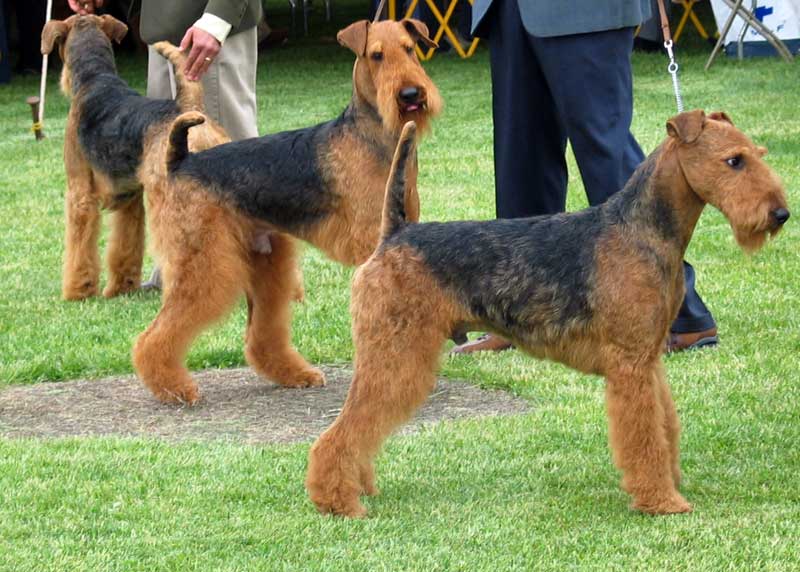
Source: Wikimedia Commons • File: Airedale_Terriers_Flickr.jpg • License: CC BY-SA 2.0 • 800×572 px (73 KB) • Author: Srinayan Puppala (TigerPuppala/Flickr) • 8 May 2005
Systematic Classification
| Taxonomic Rank | Classification |
|---|---|
| Kingdom | Animalia |
| Phylum | Chordata |
| Class | Mammalia |
| Order | Carnivora |
| Family | Canidae |
| Genus | Canis |
| Species | C. familiaris |
| Common Name | Airedale Terrier |
| Other Names | King of Terriers, Waterside Terrier, Bingley Terrier |
| AKC Group | Terrier Group (recognized 1888) |
| FCI Group | Group 3 (Terriers), Section 1, Standard No. 7 |
| Country of Origin | England (Yorkshire) |
Kennel Club Recognition
- AKC (USA): Recognized since 1888; Terrier Group; one of the earliest terriers recognized by the American Kennel Club; fully documented breed standard.
- FCI: Group 3 (Terriers), Section 1 (Large and Medium-sized Terriers), Standard No. 7; patronage country England; working trial not required.
- The Kennel Club (UK): Recognized; Terrier Group; one of the foundational terrier breeds in KC history; long competitive show history at Crufts.
- UKC (USA): Recognized; Terrier Group.
- ANKC (Australia): Recognized; Terrier Group; strong historical presence in Australia and New Zealand.
Conformation Documentation

Source: Wikimedia Commons • File: Airedale_Terrier_stehend_unkupiert.JPG • License: CC BY-SA 3.0 • 1,144×859 px (326 KB) • Author: Musarati • 10 April 2009

Source: Wikimedia Commons • File: Airedale_Terrier_2.jpg • License: CC BY-SA 3.0 • 1,043×1,718 px (446 KB) • Author: Franciaio • 16 Feb 2014
FCI/AKC Physical Standards
| Feature | Standard Description |
|---|---|
| Height (male) | Approximately 23 inches (58 cm) at the withers; slightly taller than female |
| Height (female) | Slightly smaller than male; proportionate |
| Weight | 50–70 lbs (23–32 kg); well-proportioned to height |
| Skull | Long, flat skull; not too broad; well-balanced with foreface |
| Muzzle | Long and powerful; deep; strong jaw with a level mouth; scissor bite |
| Eyes | Small, dark, full of terrier expression; not prominent; alert and intelligent |
| Ears | V-shaped; small; set high; folded slightly above skull level; button-ear type |
| Neck | Clean, muscular, of moderate length; gradual widening toward shoulders |
| Body | Short, strong back; ribs well sprung; deep chest; level topline |
| Tail | Set high; carried gaily but not curled over back; customarily docked in regions where permitted |
| Legs | Perfectly straight; good bone; feet round, compact; well-cushioned pads |
| Coat | Hard, wiry, dense double coat; outer coat hard and crisp; undercoat soft |

Source: Wikimedia Commons • File: Airedale_Terrier_in_stand.JPG • License: CC BY-SA 3.0 • 1,520×1,216 px (418 KB) • CACIB Tallinn, 17-18 Aug 2013

Source: Wikimedia Commons • File: Airedale_Terrier_with_handler.JPG • License: CC BY-SA 3.0 • 2,336×1,687 px (975 KB) • CACIB Tallinn, 17-18 Aug 2013
Breed Standard Profile

Head Detail – Ultra-High Resolution Documentation

Facial Features & Expression Standards
- Head shape: Long, flat skull; well-balanced; not too broad between the ears; negligible stop; powerful foreface; the entire head projects strength and intelligence.
- Eyes: Small, dark, full of terrier expression; set well apart; never prominent or round; sparkling with alert intelligence — the “fire” of the breed.
- Ears: V-shaped; small; set high on the side of the head; folded forward so the tip touches the side of the cheek; never erect, hound-like, or set below skull level.
- Beard & furnishings: Characteristic wiry beard and eyebrow furnishings; a hallmark of Airedale type; must be of the correct wiry texture and not soft or curly.
- Nose: Black; large; open nostrils; important for tracking and scenting heritage.
- Mouth & teeth: Tight lips; strong scissor bite; powerful jaw capable of carrying game; well-developed cheek muscles.
Coat Type Documentation

Source: Wikimedia Commons • File: Airedale_terrier_744.jpg • License: CC BY-SA 3.0 • 1,520×1,296 px (272 KB) • Author: Lilly M • 25 March 2006
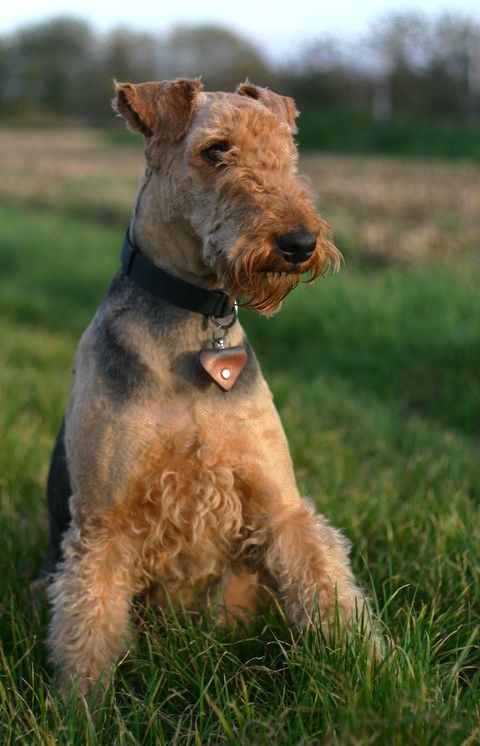
Source: Wikimedia Commons • File: AiredaleDog.jpg • License: CC BY 2.0 • 480×746 px (86 KB) • Author: Angela Montillon (Flickr) • 10 Nov 2006
Coat & Color Standards
| Coat Feature | Standard Description |
|---|---|
| Outer coat | Hard, wiry, dense; crisp to the touch; lies flat or slightly wavy; not soft or silky |
| Undercoat | Soft and fine; provides insulation and body; essential part of the double coat |
| Body color | Tan (various shades from light golden-tan to rich deep tan) |
| Saddle marking | Black or dark grizzle; covers back and upper sides from neck to root of tail |
| Top of head | Tan; ears may be darker tan |
| Legs & chest | Tan; some intermingling of black and tan on the lower legs typical |
| White markings | Not typical of the breed standard; small white spot on chest permissible |
| Grooming method | Hand-stripping preferred for show dogs; clipping acceptable for pets but alters coat texture |
Historical Documentation

Source: Wikimedia Commons • File: Airedale_Terrier_circa_1915.jpg • License: Public Domain • 378×313 px (106 KB) • W. E. Mason – Dogs of all Nations, 1915

Source: Wikimedia Commons • File: The_complete_story_of_the_Airedale_terrier_(1913).jpg • License: Public Domain • 1,370×1,028 px (389 KB) • Historic breed documentation, 1913
Origins in Victorian Yorkshire
- Geographic origin: The Airedale Valley, a section of the River Aire between Shipley and Otley in the West Riding of Yorkshire, England; named directly for this region.
- Founding crosses: Old English Black and Tan Terrier (now extinct) × Otterhound; the terrier contributed gameness and earthwork ability; the Otterhound contributed size, swimming ability, and scenting power for otter hunting.
- Original purpose: Hunting otter, water rats, and other game along the banks and waters of the River Aire; working alongside mill workers and hunters in moorland country.
- Early names: Called “Waterside Terrier” and “Bingley Terrier” before the name “Airedale Terrier” was standardized in 1879.
- 1879 standardization: The name “Airedale Terrier” officially adopted; first breed classes held; breed club formation began systematic documentation.
Development Timeline
| Period | Key Development |
|---|---|
| 1850s–1870s | Initial development in Yorkshire; known as Waterside and Bingley Terrier; hunting working dogs |
| 1879 | Name “Airedale Terrier” officially adopted; first breed-specific show classes |
| 1886 | Airedale Terrier Club formed in England; breed standard codified |
| 1888 | American Kennel Club (AKC) recognition; Terrier Group classification |
| 1900s | Breed exported to North America, Australia, Europe; police dog use begins |
| 1914–1918 | World War I military service; messenger dogs, sentinels, Red Cross dogs; legendary war dog status |
| 1920s | Peak of breed popularity; Presidential White House dogs; top show breed |
| 1950s–present | Sustained show success; working roles in police and SAR; international breed clubs |
Contemporary Specimen Documentation

Core Behavioral Profile
- Confidence: Self-assured and courageous; never shy or fearful; typical terrier boldness on a larger scale; meets challenges head-on.
- Intelligence: Highly intelligent; quick learner; strong problem-solving ability; responds well to positive reinforcement; can become bored with repetitive training.
- Loyalty: Deeply devoted to family; bonds strongly with its household; protective without being aggressive; natural guardian instinct.
- Independence: Characteristic terrier independence; makes own decisions; not blindly obedient; needs experienced, consistent handling.
- Energy & playfulness: High energy breed; loves play, exercise, and activity; excellent companion for active families and individuals.
- Prey drive: Strong prey drive reflecting hunting heritage; may not be reliable off-leash near small animals; secure fencing recommended.
Behavioral Profile Table
| Trait | Level | Notes |
|---|---|---|
| With family | Affectionate & loyal | Devoted companion; playful and fun; protective guardian |
| With strangers | Reserved to friendly | Alert but not typically aggressive; proper socialization critical |
| With children | Good if socialized | Playful with children; size and energy require supervision with young children |
| With other dogs | Variable | Same-sex aggression possible; early socialization important |
| Trainability | High | Intelligent and eager; positive reinforcement most effective; terrier independence requires patience |
| Barking tendency | Moderate to high | Alert barker; announces visitors; needs management in urban settings |
| Prey drive | High | Strong hunting heritage; secure leash and fencing essential |
Puppy Development Documentation
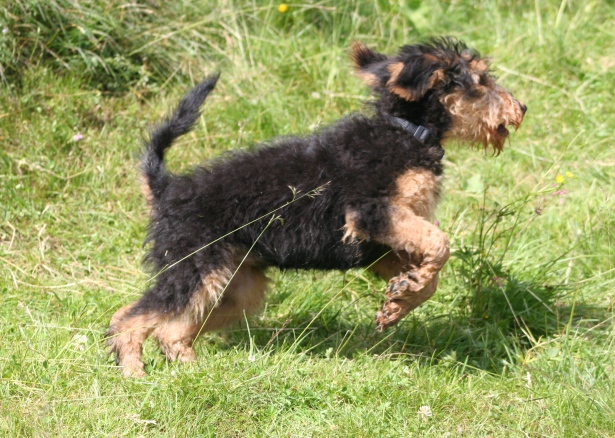
Source: Wikimedia Commons • File: Airedale_Terrier_puppy.jpg • License: CC BY-SA 3.0 • 615×438 px (214 KB) • Author: Franciaio • 14 July 2013

Source: Wikimedia Commons • File: Young_Airedale_Terrier_29-07-2009.jpg • License: CC BY-SA 3.0 • 2,048×1,536 px (2.27 MB) • 29 July 2009 • 9 months, still in coat transition
Developmental Stages
- Birth to 8 weeks: Neonatal and transitional periods; eyes and ears open at approximately 2 weeks; socialization with littermates begins; breeder-managed early neurological stimulation recommended.
- 8–16 weeks: Primary socialization window; critical period for exposure to varied environments, sounds, people, and animals; foundation training begins; first vaccinations and veterinary care.
- 4–12 months: Adolescent period; strong curiosity; testing boundaries; continued training and socialization essential; terrier independence begins to emerge.
- 12–24 months: Approaching adult size; adult coat developing from puppy coat; behavioral maturity lags physical maturity; training consistency crucial.
- 2+ years: Full maturity; adult coat established; character fully developed; excellent working and companion capability.
International Competition Documentation
CC BY-SA 3.0 • 1,520×1,216 px • FCI CACIB event, Tallinn, Estonia
CC BY-SA 3.0 • 2,336×1,687 px • Professional handling at FCI level
Competition History
- Westminster Kennel Club: Long history at America’s premier dog show; multiple Airedale Terrier Best in Show wins; recognized as a top-tier Terrier Group contender historically.
- Crufts (UK): Multiple significant placements at Crufts, the world’s largest dog show; consistent Terrier Group representation; UK breed club actively promotes Crufts competition.
- FCI World Shows: International FCI competition participation across Europe, Asia, and the Americas; CACIB (Certificat d’Aptitude au Championnat International de Beauté) title competition.
- Agility & obedience: Airedales compete successfully in AKC/FCI obedience, agility, tracking, and earthdog trials; demonstrate versatility beyond conformation showing.
Historical & Contemporary Working Functions
- Hunting: Original purpose; otter and small game hunting along Yorkshire waterways; water-resistant coat and Otterhound heritage enabled river and fen work; strong nose and terrier tenacity.
- Military (WWI): Served British and American forces as messenger dogs, sentinels, and Red Cross casualty dogs during World War I; individual Airedales awarded posthumous commendations for bravery in battle.
- Police work: Among the early police dog breeds; served in British police forces before German Shepherds became dominant; still occasionally used in law enforcement contexts.
- Search & Rescue: Excellent scenting ability and athleticism make the Airedale a capable SAR dog; used in disaster and wilderness search operations.
- Therapy & assistance: Intelligent and trainable; some Airedales serve as therapy and emotional support animals; their friendly yet alert nature suits interaction with vulnerable populations.
- Dog sports: Competitive agility, obedience, tracking, earthdog, and Schutzhund/IPO; demonstrates the breed’s mental and physical versatility beyond the show ring.
General Health Status
The Airedale Terrier is generally a healthy and robust breed with a typical lifespan of 11–15 years. Like all purebred dogs, the breed carries some hereditary health conditions that responsible breeding programs actively screen for and work to minimize.
| Health Condition | Prevalence | Notes |
|---|---|---|
| Hip Dysplasia | Moderate | OFA/BVA hip evaluation recommended for breeding animals; genetic screening for responsible breeding programs |
| Elbow Dysplasia | Moderate | Elbow evaluation via OFA/BVA recommended; associated with developmental orthopedic disease |
| Colonic Myopathy | Breed-specific | Rare but breed-associated condition affecting large intestine muscle function; awareness important |
| Sebaceous Adenitis | Moderate | Inflammatory skin disease affecting sebaceous glands; presents with scaling, hair loss; treatable |
| Hypothyroidism | Moderate | Underactive thyroid; manageable with medication; thyroid testing recommended for breeding animals |
| Bloat (GDV) | Moderate risk | Deep-chested breed carries gastric dilatation-volvulus risk; feeding management and awareness important |
| Allergies | Moderate | Environmental and food allergies reported; dietary management and veterinary guidance helpful |
Veterinary Care Recommendations
- Hip & elbow screening: OFA or BVA evaluation of all breeding animals; mandatory for reputable breeders; results registered in public health databases.
- Thyroid testing: Regular thyroid function testing recommended; annual thyroid panel for breeding animals.
- Eye examination: Annual CAER/BVA eye examination for breeding dogs; screens for hereditary eye conditions.
- Dental care: Regular professional dental cleaning; at-home brushing to prevent periodontal disease.
- Weight management: Monitor body condition; Airedales can become overweight if under-exercised; maintain lean athletic condition.
- Lifespan: 11–15 years; good longevity for a medium-to-large breed; appropriate care and exercise support healthy aging.
Responsible Breeding Standards
- Health testing: Responsible breeders perform OFA/BVA hip and elbow evaluations, thyroid panels, eye exams, and cardiac screening; results published in breed health databases; health testing is the hallmark of ethical breeding.
- Conformation assessment: Breeding animals should demonstrate correct conformation per FCI/AKC breed standard; show titles and evaluations by qualified judges provide objective assessment.
- Temperament evaluation: Sound, confident, friendly-yet-alert temperament is central to the breed; fearful or overly aggressive animals excluded from breeding programs.
- Genetic diversity: Coefficient of inbreeding (COI) monitoring recommended; avoiding excessive line-breeding; international cooperation for genetic diversity maintenance.
Whelping & Puppy Development
- Litter size: Typically 6–12 puppies; large litters possible due to breed size; individual variation.
- Puppy socialization: Reputable breeders begin socialization from 3–4 weeks; Puppy Culture or Avidog protocols; exposure to varied stimuli during critical socialization window.
- Screening: Puppies evaluated for soundness, conformation, and early temperament before placement; health guarantees standard in reputable breeding programs.
- Breed clubs: National and regional Airedale Terrier clubs provide breeder referral and health screening resources; breed club membership a positive indicator of commitment.
Exercise & Activity Needs
- Daily exercise: 1–2 hours of vigorous daily exercise; Airedales thrive with activities including running, hiking, swimming, fetch, and agility; mental stimulation as important as physical exercise.
- Space requirements: Best suited to homes with securely fenced yards; not ideal for apartment living unless owners commit to extensive daily outings; strong athletic dog requires containment.
- Mental stimulation: Highly intelligent breed requires mental engagement; training sessions, puzzle toys, scent work, and interactive play prevent boredom-related behavior.
Grooming
- Hand-stripping: Preferred method for show dogs; removes dead outer coat by hand to stimulate new wiry growth; maintains correct coat texture; requires training and time.
- Clipping: Acceptable for companion dogs; quicker and more economical; alters coat texture over time (softens the wiry coat); professional grooming every 6–8 weeks.
- Brushing: Weekly brushing to remove loose hair and prevent matting; more frequent during coat changes; attention to beard and furnishings for cleanliness.
- Beard care: The characteristic beard requires regular cleaning after meals and outdoor activities; check for food residue and tangles.
Owner Requirements
- Experience level: Suitable for confident, experienced dog owners; first-time dog owners must be prepared for a strong-willed, energetic terrier; not recommended as a first large breed dog.
- Training commitment: Consistent positive reinforcement training from puppyhood; puppy classes strongly recommended; ongoing training through adolescence; mental engagement throughout life.
- Nutrition: High-quality protein-rich diet appropriate for active medium-to-large breed; avoid overfeeding; two meals daily for adults to reduce bloat risk.
1. What is the Airedale Terrier’s origin?
Airedale Terriers originated in the Airedale Valley of Yorkshire, England, developed in the 1850s–1870s by crossing the Old English Black and Tan Terrier with the Otterhound. The goal was a larger terrier capable of hunting otter in the River Aire while retaining terrier gameness and drive.
2. Why is the Airedale called the King of Terriers?
The Airedale earned the title “King of Terriers” because it is the largest of all 31 AKC-recognized terrier breeds, standing approximately 23 inches at the shoulder. The title also reflects the breed’s versatility, intelligence, and distinguished service history.
3. How large do Airedale Terriers get?
Airedale Terriers stand approximately 23 inches (58 cm) at the shoulder and typically weigh 50–70 pounds (23–32 kg). Males are typically larger than females but both sexes are similar in height per breed standard.
4. What does an Airedale Terrier coat look like?
The Airedale has a hard, wiry, dense double coat. The standard color is tan body (ranging from golden-tan to deep rich tan) with a black or dark grizzle saddle covering the back and upper sides. A characteristic wiry beard and eyebrow furnishings complete the appearance.
5. Are Airedale Terriers good family pets?
With proper training and socialization, Airedales make excellent family companions. They are loyal, playful, and protective. However, their size, energy level, and independent terrier nature are best suited to experienced dog owners with active lifestyles.
6. How much exercise do Airedale Terriers need?
Airedales require 1–2 hours of vigorous exercise daily. They excel at activities like hiking, swimming, agility, and fetch. Mental stimulation through training and interactive play is equally important to their wellbeing.
7. Are Airedale Terriers good with children?
Airedales raised with children can be playful, affectionate companions for them. Their size and boisterous energy mean supervision with young children is recommended. They do best when children are taught to interact respectfully with dogs.
8. How intelligent are Airedale Terriers?
Airedale Terriers are highly intelligent with strong problem-solving abilities. They have served as police dogs, military dogs, and compete successfully in obedience, agility, tracking, and scent work. Their intelligence requires ongoing mental stimulation to prevent boredom and destructive behavior.
9. What health issues affect Airedale Terriers?
Common health considerations include hip dysplasia, elbow dysplasia, hypothyroidism, sebaceous adenitis, colonic myopathy, and allergies. Responsible breeders screen for hereditary conditions and provide health guarantees. Regular veterinary care supports longevity.
10. How long do Airedale Terriers live?
Airedale Terriers typically live 11–15 years with proper care, nutrition, and exercise — good longevity for a medium-to-large breed. Some individuals live beyond 15 years with excellent health management.
Explore our trusted network of partner websites covering directories, encyclopedias, marketplaces, education, health, finance, and more across Indonesia and beyond.
- This encyclopedia is educational in nature and reflects current breed documentation as of March 2026.
- All images sourced exclusively from Wikimedia Commons with verified open licenses (CC BY-SA 4.0, CC BY-SA 3.0, CC BY 2.0, Public Domain).
- Image URLs verified from Wikimedia Commons MediaSearch (search term: “Airedale Terriers”); only Airedale Terrier-specific images included.
- Health information is for general educational purposes; consult a qualified veterinarian for specific health advice.
Primary References
- AKC: American Kennel Club Airedale Terrier Breed Standard; Terrier Group classification; official recognition documentation since 1888.
- FCI: Fédération Cynologique Internationale Standard No. 7; Group 3 (Terriers), Section 1; patronage country England; current FCI standard.
- The Kennel Club (UK): UK Kennel Club breed standard; Terrier Group; historical breed registration records.
- Airedale Terrier Club: Founded 1886; original breed club documentation; breed standard development records.
- Historical sources: W. E. Mason “Dogs of All Nations” (1915); “The Complete Story of the Airedale Terrier” (1913).
Image Attribution Summary (15 Images)
- Hero image: Airedale_Terrier.jpg (5/52/, CC BY-SA 3.0, 250×205, Aus/NZ Champion, 21 Jul 2011)
- Intro gallery: Airedale_terrier.jpg (b/bd/, CC BY-SA 2.0, 1024×683, Ioan Bodean) • Airedale_Terriers_Flickr.jpg (9/9e/, CC BY-SA 2.0, 800×572, S. Puppala, 2005)
- Conformation: Airedale_Terrier_stehend_unkupiert.JPG (8/8b/, CC BY-SA 3.0, 1144×859) • Airedale_Terrier_2.jpg (1/1f/, CC BY-SA 3.0, 1043×1718, Franciaio, 2014) • Airedale_Terrier_Fond_Blanc.jpg (1/11/, CC BY-SA 3.0, 583×494, Desaix83, 2015)
- Show: Airedale_Terrier_in_stand.JPG (5/58/, CC BY-SA 3.0, 1520×1216) • Airedale_Terrier_with_handler.JPG (8/85/, CC BY-SA 3.0, 2336×1687) — both CACIB Tallinn 2013
- Head study: Airedale_terrier_head%2C_Josselin_01.jpg (b/b5/, CC BY-SA 4.0, 4000×3000)
- Coat/color: Airedale_terrier_744.jpg (7/7a/, CC BY-SA 3.0, 1520×1296, Lilly M, 2006) • AiredaleDog.jpg (4/43/, CC BY 2.0, 480×746, Angela Montillon, 2006)
- History: Airedale_Terrier_circa_1915.jpg (6/6c/, Public Domain, 378×313) • The_complete_story_of_the_Airedale_terrier_(1913).jpg (a/a1/, Public Domain, 1370×1028)
- Contemporary: Airedale_terrier_in_B%C4%99dzin…October_2024.jpg (f/f4/, CC BY-SA 4.0, 1555×1167, Oct 2024)
- Puppies: Airedale_Terrier_puppy.jpg (0/06/, CC BY-SA 3.0, 615×438, Franciaio, 2013) • Young_Airedale_Terrier_29-07-2009.jpg (2/21/, CC BY-SA 3.0, 2048×1536)
About the Author: Encyclopedia.guru Expert Writing Team
The Encyclopedia.guru writing team consists of experienced canine researchers, certified dog breed specialists, veterinary consultants, and professional animal science writers with decades of combined experience. Specialists in terrier breeds, working dog history, AKC/FCI breed standards, and canine health genetics.
🌐 Visit Encyclopedia.guru – 100+ comprehensive breed encyclopedias.
© 2026 – Encyclopedia.guru – Airedale Terrier Encyclopedia (Canis familiaris)
King of Terriers • Yorkshire England origins • AKC Terrier Group • FCI Group 3 Standard No. 7 • 15 Wikimedia Commons images with full attribution • Updated: 19 March 2026