🐕 Rough Collie Dog Encyclopedia (Canis lupus familiaris)
Complete professional breed reference: Scottish Highland origins & medieval history, physical conformation standards, double coat genetics & colour varieties, temperament analysis, health predispositions (MDR1 mutation, Collie Eye Anomaly, dermatomyositis), grooming protocols, training methodologies, nutrition optimisation, exercise requirements, and comprehensive ownership guide
By Encyclopedia.guru Expert Writing Team | Published: March 2, 2026 | Updated: March 2, 2026 | Reviewed by Certified Breed Specialists, Veterinary Consultants & Canine Geneticists

File: Rough_Collie_600.jpg
License: CC BY-SA 3.0 (Creative Commons Attribution-ShareAlike)
Subject: Championship Rough Collie at the City of Birmingham Championship Dog Show (2003) showing characteristic sable and white coat, refined head, and breed-standard conformation
Usage Note: Image used under Creative Commons CC BY-SA 3.0 licensing with proper attribution for non-commercial educational breed documentation.
The Rough Collie (also known as the Long-Haired Collie) is a British breed of long-coated herding dog of medium to large size, originating in Scotland and Northern England. It is identical to the Smooth Collie in all respects except the length of the coat, and ranks among the most recognisable and beloved dog breeds in the world, largely owing to the fictional character Lassie. The breed’s combination of intelligence, loyalty, elegant appearance, and gentle temperament has sustained its popularity for more than 150 years.
What makes the Rough Collie particularly fascinating is how its physical structure directly correlates to its historical function. Originally bred to herd sheep across the rugged Scottish Highlands, the breed’s moderate size, keen intelligence, and profuse double coat allowed it to work tirelessly in harsh weather over challenging terrain. When Queen Victoria acquired Rough Collies after seeing them at Balmoral Castle in the 1860s, the breed was transformed from a working farm dog into a fashionable companion—a transition that fundamentally shaped its modern development. For related herding breeds, see our Belgian Sheepdogs (Groenendael) and Belgian Shepherd Tervuren encyclopedias.
- Origin: Scotland & Northern England; medieval herding dogs selectively bred for centuries; standardised in the Victorian era from the 1860s onward.
- Royal patronage: Queen Victoria popularised the breed after visiting Balmoral Castle, transforming it from a working sheepdog into a fashionable companion.
- Lassie legacy: The 1943 film Lassie Come Home and subsequent TV series (1954–1973) made the Rough Collie arguably the most recognisable dog breed worldwide.
- MDR1 mutation: 30–40% of Rough Collies carry the MDR1 gene mutation, causing hypersensitivity to ivermectin and certain other medications. DNA testing essential.
- Collie Eye Anomaly: Congenital eye disorder with autosomal recessive inheritance; highly prevalent in the breed; puppies screened at 6–8 weeks.
- Grooming: Requires 3–4 hours weekly minimum brushing; daily during seasonal shedding; professional grooming every 6–8 weeks.
- Temperament: AKC describes as “active, intelligent, and exceptionally loyal” with a “wholly devoted” and friendly disposition.
- Lifespan: 12–14 years typical; some reach 15–16 years with optimal care, health screening, and weight management.
Breed Classification & Recognition
- AKC Group: Herding Group (recognised since 1885; Collie Club of America founded 1886)
- The Kennel Club (UK): Pastoral Group
- FCI Classification: Group 1 (Sheepdogs and Cattle Dogs) – Section 1 (Sheepdogs)
- Original Purpose: Herding sheep in the Scottish Highlands and Border regions
- Modern Roles: Companion dog, show dog, therapy dog, agility & obedience competitor, occasional herding work
Why Rough Collies Have Endured
The Rough Collie’s sustained popularity over more than 150 years stems from an exceptional combination of traits: an instantly recognisable elegant silhouette creating universal appeal, moderate size suitable for various living situations, high intelligence and trainability enabling versatile working ability, gentle temperament making them ideal family companions, and cultural icon status through literary works (Albert Payson Terhune’s novels) and media representation (the Lassie franchise). The breed consistently ranks among the top 30 most registered breeds with the American Kennel Club, demonstrating sustained appeal across generations.
Both the Rough and the Smooth Collie descend from a localised variety of herding dog originating in Scotland and Wales. The Scottish variety was a large, strong, aggressive dog bred to herd Highland sheep, while the Welsh variety was smaller, nimbler, and domesticated, used also for herding goats. When English breeders encountered these dogs at the Birmingham market, they were interbred with English sheepdogs, producing both short-haired and long-haired varieties.
Medieval Origins & the Scottish Highlands (Pre-1800s)
The breed’s name most likely derives from the “Colley” (black-faced) sheep of Scotland, though the exact etymology remains debated—it may also trace to the Scots word for “coal” (describing the dog’s early dark colour) or from Gaelic càilean meaning “doggie.” For centuries before formal standardisation, Collie-type dogs were valued by Scottish shepherds for their intelligence, herding instinct, and ability to traverse rough terrain. These early dogs were generally smaller than modern show dogs and selected exclusively for working ability rather than appearance.
Queen Victoria & Victorian Standardisation (1860s–1890s)
The modern history of the Rough Collie began during the reign of Queen Victoria, who became interested in the shepherds’ dogs while visiting Balmoral Castle in Scotland. In the 1860s she purchased several for her own kennel, and with the Queen’s interest it became fashionable to own Collies. Continued breeding for show purposes drastically transformed the breed’s appearance. During this period, the breed was believed to have been crossed with the Borzoi (Russian Wolfhound) to produce a more refined, elongated head—one of the true characteristics of the modern Rough Collie—though this cross has never been conclusively confirmed.
| Year | Event | Significance |
|---|---|---|
| 1859 | Collies first exhibited at English dog shows | Beginning of formal breed recognition beyond Scotland |
| 1868 | Birth of “Old Cockie,” first recorded sable Collie | Sable and white becomes the breed’s most popular colour variety |
| 1870 | Separate show classes for “Sheepdogs Rough” and “Sheepdogs Smooth” | Rough and Smooth Collies formally distinguished |
| 1873 | The Kennel Club (UK) established; Collie breeds registered | Formal breed documentation and standardisation begins |
| 1881 | Collie Club formed in England | First breed-specific club; breed standards codified |
| 1885 | American Kennel Club recognises the Collie | Rapid popularity growth in the United States |
| 1886 | Collie Club of America established | One of the oldest breed-specific clubs in the United States |
American Development & the Lassie Era
Men and women of great wealth began appearing on the Collie scene during the late 1800s. The most influential early American breeder was the world-famous financier J.P. Morgan, who purchased an English champion and established his Cragston Kennels on the banks of the Hudson in 1888. Albert Payson Terhune’s novels about his Sunnybank Collies made the breed a literary icon in the early twentieth century.
The 1943 film Lassie Come Home, starring a Rough Collie named Pal (owned by trainer Rudd Weatherwax), catapulted the breed to global fame. Despite Lassie being a female character, all nine dogs that portrayed Lassie throughout the MGM films and television series (1954–1973) were male. Lassie secured a star on the Hollywood Walk of Fame and was the only animal to feature on Variety’s “100 Icons of the Century” in 2005.
Modern Era
In the UK, the Rough Collie is no longer widely used for serious herding, having been replaced by the Border Collie. However, in the United States and several other countries, interest in the breed as a working and performance dog has seen a resurgence. Since the 1990s, responsible breeding practices have been emphasised, with health testing (particularly for MDR1 and Collie Eye Anomaly) becoming standard among reputable breeders. For related historical breeds, see our Afghan Hounds and Bloodhounds encyclopedias.
Modern Rough Collie breed photography demonstrates consistent breed type maintained across more than 140 years of formal standardisation, from Victorian-era illustrations to contemporary championship specimens.
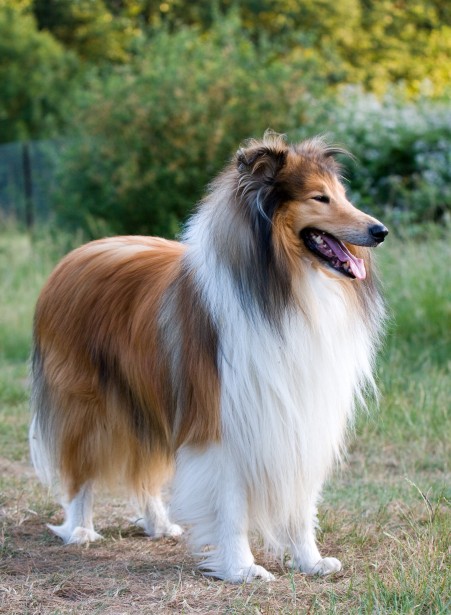
Source: Wikimedia Commons | CC BY-SA | Characteristic breed expression showing refined head and profuse coat

Source: Wikimedia Commons | CC BY-SA | 3285×2661px | Athletic capability and grace documentation
Source: Wikimedia Commons | CC BY-SA 3.0 | Modern breed standard conformation reference
General Appearance
According to The Kennel Club (UK), the Rough Collie should appear as a “dog of great beauty, standing with impassive dignity, with no part out of proportion to whole, giving the appearance of working capability.” The AKC standard describes the Collie as “a lithe, strong, responsive, active dog, carrying no useless timber, standing naturally straight and firm.”
- Overall Balance: Elegant, refined proportions expressing both grace and working capability; never cloddy or coarse.
- Body Proportions: Slightly longer than tall; well-developed forechest; level topline; athletic build.
- Substance: Medium to large size with moderate, round bone; refined without being spindly.
- Movement: Distinctly characteristic gait; front feet move comparatively close together; smooth, effortless stride with powerful rear drive.
Size & Weight Standards
| Measurement | Males | Females |
|---|---|---|
| Height at Withers | 24–26″ (61–66 cm) | 22–24″ (56–61 cm) |
| Weight Range | 60–75 lbs (27–34 kg) | 50–65 lbs (23–29 kg) |
| Body Length | Slightly longer than height; athletic, elegant proportions | |
Head & Expression
- Skull: Flat; resembles a well-blunted, clean wedge tapering from ears to nose; skull and muzzle of equal length.
- Stop: Slight but perceptible; top of skull and muzzle in two parallel planes.
- Eyes: Medium-sized, almond-shaped, dark brown (blue or merle eyes permitted in blue merles); expression full of intelligence.
- Ears: Small, set moderately high, carried semi-erect with upper third tipping forward naturally; characteristic of alertness.
- Nose: Black (blue merles may have lighter pigmentation); completely pigmented.
Gait & Movement
The Kennel Club standard states: “A sound dog is never out at the elbow, yet moves with front feet comparatively close together. Plaiting, crossing or rolling are highly undesirable. Hindlegs from hock joint to ground when viewed from rear to be parallel but not too close.” Movement should be smooth, light, and appear effortless with plenty of rear drive. For comparison with another elegant breed, see our Borzoi encyclopedia.
The Rough Collie’s double coat is the breed’s defining physical characteristic and the primary feature distinguishing it from the Smooth Collie. For grooming techniques for similar double-coated breeds, see our Chow Chow and Alaskan Malamute encyclopedias.
Coat Structure & Texture
- Outer Coat: Long (3–4 inches minimum on body), straight, harsh in texture, and glossy; should stand somewhat away from the body.
- Undercoat: Dense, soft, woolly; provides excellent insulation against cold and wet; thickest in winter.
- Furnishings: Notable ruff around the neck; feathering on legs; “petticoat” on abdomen; frill on hindquarters; profuse tail plume.
- Texture Importance: Harsh outer coat must contrast with soft undercoat; proper texture is essential for breed type.
- Never Shave: The coat should never be shaved, as this removes natural protection and alters the distinctive colouring.
Recognised Colour Patterns
| Colour | Description | Prevalence |
|---|---|---|
| Sable & White | Ranges from pale golden tan to deep mahogany; white markings on collar, blaze, chest, legs, tail tip | Most common (~50%+ of breed) |
| Tricolour | Predominantly black body with tan markings on face and legs, white markings | Common (~30%) |
| Blue Merle | Silvery grey/blue body with black mottling; may have tan points and white markings | Less common (~15%) |
| Colour-Headed White | Predominantly white body with coloured head (sable, tricolour, or blue merle) and sometimes body patches | Rare; accepted by AKC |
Seasonal Shedding (“Blowing Coat”)
- Shedding Pattern: Seasonal rather than continuous; intact females blow coat after each oestrus cycle (~every 7–10 months).
- Spayed/Neutered & Males: Shed undercoat once annually, usually mid-to-late summer.
- Heaviest Period: Spring shed (March–May) is most intensive; daily brushing essential during this period.
- Key Rule: All grooming should be completed before bathing; water tightens existing mats.
The Rough Collie temperament reflects centuries of selective breeding for herding ability combined with close human companionship. The Kennel Club (UK) standard specifies: “Friendly disposition with no trace of nervousness or aggressiveness. A great companion dog, friendly, happy and active, good with children and other dogs.”
Core Temperament Traits
- Intelligence: Ranks among the most intelligent dog breeds; learns new commands in approximately 5 repetitions or fewer.
- Loyalty: Forms intense bonds with entire families; displays equal devotion to all household members.
- Gentleness: Exceptional patience with children; natural protective instinct expressed through alert barking, not aggression.
- Sensitivity: Responds best to positive reinforcement; shuts down emotionally with harsh corrections.
- Independence: Herding heritage provides capacity for independent problem-solving and decision-making.
- Vocality: Moderate-to-high barking tendency; deeply rooted in herding communication instinct.
Behavioural Profile
| Context | Behaviour |
|---|---|
| With Family | Intensely devoted, gentle, protective; bonds with all household members equally |
| With Children | Excellent; patient, gentle, naturally protective; one of the best breeds for families |
| With Other Dogs | Generally friendly when socialised; rarely aggressive; may attempt to herd |
| With Strangers | Reserved but polite; alert and watchful; not typically aggressive |
| Prey Drive | Low-to-moderate; herding instinct may manifest as chasing/circling |
| Trainability | Highly trainable; eager to please; responds excellently to positive reinforcement |
Common Behavioural Considerations
Excessive Barking
Excessive barking is the most frequently cited challenge of Rough Collie ownership. The behaviour has deep roots in the breed’s herding instinct, where vocalisation served as a tool for communicating with sheep and alerting shepherds. Common triggers include boredom, insufficient exercise, excitement, separation anxiety, and environmental stimuli. While barking cannot be eliminated entirely, it can be managed through adequate physical and mental stimulation, training the “quiet” command, and addressing underlying causes.
Separation Anxiety
The breed’s strong bonding instinct (“Velcro dog” tendency) can result in separation anxiety if not managed proactively. Prevention through gradual crate training from puppyhood, systematic desensitisation to departures, and independence training is far more effective than treating established anxiety. Severe cases may require veterinary-guided behavioural modification. For a comparison with another bonding-oriented breed, see our Cocker Spaniel encyclopedia.
While Rough Collies are generally resilient dogs with a lifespan of 12–14 years, several hereditary conditions occur with increased frequency due to selective breeding practices. Responsible breeders routinely screen for these conditions. For comparative breed health insights, see our Cocker Spaniel Health & Preventive Care encyclopedia.
1. MDR1 Gene Mutation (Major Concern)
- Genetic Mechanism: Mutation affects blood-brain barrier function and drug metabolism.
- Testing: DNA testing available (~$100–200); veterinarians must be informed of MDR1 status.
- Management: Safe alternative medications prescribed; MDR1 status documented on medical records.
- Breeding Ethics: Responsible breeders test all breeding stock and disclose results.
2. Collie Eye Anomaly (CEA) (Major Concern)
- Screening: Puppies should be examined by a veterinary ophthalmologist at 6–8 weeks of age.
- DNA Testing: Available through UC Davis Veterinary Genetics Laboratory and other labs.
- Breeding Approach: Elimination must proceed carefully to avoid excessively shrinking the gene pool.
Other Health Predispositions
| Condition | Description | Management |
|---|---|---|
| Dermatomyositis (DMS) | Immune-mediated disorder affecting skin and muscle; lesions typically develop by age one | Genetic testing available; affected dogs should not be bred |
| Hip Dysplasia | Abnormal hip joint development; relatively rare compared to similar-sized breeds | OFA or PennHIP screening; weight management |
| Progressive Retinal Atrophy (rcd2) | Bilateral retinal degeneration causing progressive vision loss | DNA test available; more prevalent in UK lines |
| Cyclic Neutropenia (“Gray Collie Syndrome”) | Cyclic blood disorder causing periodic immune system weakening; usually fatal in puppyhood | DNA testing detects carriers of the recessive gene |
| Bloat (GDV) | Life-threatening stomach torsion; affects deep-chested breeds | Emergency treatment required; preventive gastropexy may be recommended |
Recommended Health Testing Protocol
- MDR1 Testing: DNA test for all breeding dogs and pet Collies
- CEA/CH Screening: Ophthalmologic exam at 6–8 weeks + DNA test
- Hip Evaluation: OFA or PennHIP
- Eye Examination: Annual CERF/OFA by board-certified ophthalmologist
- DMS Testing: Genetic testing for dermatomyositis
- PRA (rcd2): DNA test for progressive retinal atrophy
Grooming & Coat Maintenance
Grooming represents the single largest ongoing commitment of Rough Collie ownership. For detailed grooming techniques for related breeds, see our Cocker Spaniel Grooming Guide and Clumber Spaniel encyclopedia.
- Minimum Brushing: 2–3 times weekly with slicker brush and pin brush; always brush from the skin outward.
- Recommended: 4–6 times weekly for healthier coat and easier long-term maintenance.
- Shedding Season: Daily brushing essential during spring and autumn; undercoat rake required.
- Professional Grooming: Every 6–8 weeks strongly recommended ($75–150 per session).
- Essential Tools: Slicker brush, pin brush, metal comb (medium-to-wide teeth), undercoat rake, detangling spray.
- Key Rule: Never brush a completely dry coat; use grooming mist to prevent breakage.
Exercise & Activity Requirements
- Daily Minimum: 1–2 hours of activity including walks, play sessions, and mental stimulation.
- Mental Stimulation: Training sessions, puzzle toys, interactive games essential for this intelligent breed.
- Ideal Activities: Herding trials, agility, obedience, flyball, tracking, therapy work, hiking.
- Not Suitable For: Completely sedentary lifestyles or apartments without regular substantial exercise.
Nutrition & Feeding
- Quality: High-quality food with appropriate protein levels for an active medium-large breed.
- Schedule: Adults fed twice daily; puppies 3–4 times daily until 6 months, then twice daily.
- Weight Management: Critical; excess weight increases joint stress, exacerbates hip dysplasia, elevates diabetes risk, and reduces lifespan.
- Bloat Prevention: Avoid vigorous exercise immediately before/after meals; use slow-feeder bowls if eating too quickly.
Cost of Ownership
| Expense Category | First Year (USD) | Annual Ongoing (USD) |
|---|---|---|
| Purchase/Adoption | $800–2,500 | — |
| Food (high-quality) | $600–1,000 | $600–1,000 |
| Grooming (professional + supplies) | $1,000–1,500 | $900–1,500 |
| Routine Veterinary Care | $500–1,000 | $400–800 |
| Training Classes | $200–600 | $100–300 |
| Supplies & Enrichment | $300–600 | $100–300 |
| Emergency/Health Issues | $0–3,000+ | $0–2,000 |
Is a Rough Collie Right for You?
Rough Collies Excel With:
- Active families who enjoy outdoor activities with a dog
- Owners committed to 3–4+ hours weekly grooming (more during shedding)
- Households with securely fenced gardens/yards and exercise areas
- People who value intelligence, trainability, and a devoted companion
- Families with children—one of the best breeds for family life
NOT Suitable For:
- Owners unable or unwilling to commit to regular grooming
- People intolerant of barking (moderate-to-high breed tendency)
- Households where the dog is left alone for long periods (separation anxiety risk)
- Consistently hot climates without adequate cooling (heavy coat creates heat stress)
- People severely allergic to dogs (significant shedding)
For alternative family-friendly breeds, see our Beagle, Chihuahua, and Bull Terrier encyclopedias.
1. What is the average lifespan of a Rough Collie?
12–14 years on average. Some individuals reach 15–16 years with proper care, balanced nutrition, regular veterinary check-ups, genetic health screening, and weight management.
2. What is the MDR1 gene mutation?
MDR1 (Multidrug Resistance 1) affects the P-glycoprotein transporter, making 30–40% of Rough Collies hypersensitive to certain medications including ivermectin. DNA testing is available and strongly recommended. Overdoses of affected drugs can cause neurological damage or death.
3. What is Collie Eye Anomaly (CEA)?
A congenital eye disorder (choroidal hypoplasia) caused by improper development of inner eye structures. Inherited as autosomal recessive and highly prevalent in the breed. Severity ranges from asymptomatic to blindness. Screening at 6–8 weeks and DNA testing are available.
4. How much grooming does a Rough Collie need?
Minimum 2–3 times weekly brushing (3–4 hours weekly), increasing to daily during seasonal shedding. Professional grooming every 6–8 weeks is strongly recommended. The breed should never be shaved.
5. Are Rough Collies good family dogs?
Excellent. The AKC standard describes them as “active, intelligent, and exceptionally loyal” with a friendly disposition. They are patient with children, bond with entire families, and demonstrate natural protective instincts through alert barking.
6. Do Rough Collies bark a lot?
Yes, Rough Collies have moderate-to-high barking tendencies rooted in herding heritage. This can be managed through adequate exercise, mental enrichment, and training, but cannot be completely eliminated. Prospective owners must accept some vocalisation as inherent to the breed.
7. How much exercise do they need?
1–2 hours of daily exercise including walks, play sessions, and mental stimulation. They excel in agility, obedience, herding trials, and flyball. Insufficient exercise leads to behavioural issues.
8. What are the recognised coat colours?
Sable and white (most common, ~50%+), tricolour (black/tan/white, ~30%), blue merle (~15%), and colour-headed white (rare). The sable variety, established by the 1868 dog “Old Cockie,” remains the breed’s most iconic colour.
Genetics & Health
- Mealey, K.L. et al. (2001). “Ivermectin sensitivity in collies is associated with a deletion mutation of the mdr1 gene.” Pharmacogenetics, 11(8), 727–733.
- Lowe, J.K. et al. (2003). “Linkage mapping of the primary disease locus for Collie Eye Anomaly.” Genomics, 82(1), 86–95.
- Parker, H.G. et al. (2006). “Breed relationships facilitate fine-mapping studies.” Genome Research, 17(11), 1562–1571.
- UC Davis Veterinary Genetics Laboratory. “Collie: Recommended Tests.” Available at: vgl.ucdavis.edu/breed/collie
Behaviour & Intelligence
- Coren, S. (1994). The Intelligence of Dogs: A Guide to the Thoughts, Emotions, and Inner Lives of Our Canine Companions. Free Press.
- Serpell, J.A. & Hsu, Y. (2005). “Effects of breed, sex, and neuter status on trainability in dogs.” Anthrozoös, 18(3), 196–207.
Breed Standards & Historical
- American Kennel Club. “Collie Breed Standard.” akc.org/dog-breeds/collie
- The Kennel Club (UK). “Collie (Rough) Breed Standard.” royalkennelclub.com
- FCI. “Collie Rough Breed Standard No. 156.” fci.be
- Collie Club of America. “Health Statement.”
- Terhune, A.P. Lad: A Dog (1919); Bruce (1920). Sunnybank Collie literary works.
- This encyclopedia is educational and reflects current breed science as of March 2026.
- Health information is general guidance; consult a qualified veterinarian for specific medical advice.
- Training recommendations are based on current behavioural science.
- All images from Wikimedia Commons with Creative Commons licensing and full attribution.
Image Attribution Summary
- Featured: Rough_Collie_600.jpg – Wikimedia Commons CC BY-SA 3.0 | City of Birmingham Championship Dog Show (2003)
- Gallery 1: 1Dog-rough-collie-portrait.jpg – Wikimedia Commons CC BY-SA | Sable & white portrait study
- Gallery 2: Rough_Collie_japan05.jpg – Wikimedia Commons CC BY-SA | Dynamic action photograph (2017)
- Gallery 3: Rough_Collie_600.jpg – Wikimedia Commons CC BY-SA 3.0 | Championship conformation reference
All images used for non-commercial educational breed documentation under Creative Commons licensing with full attribution. Image alt text, source information, and copyright rules provided for each image.
About the Author: Encyclopedia.guru Expert Writing Team
The Encyclopedia.guru writing team consists of experienced canine researchers, certified breed specialists, veterinary consultants, canine geneticists, and professional animal science writers with collectively hundreds of comprehensive breed encyclopedias authored.
Credentials: Certified Canine Geneticists • Veterinary Consultants • AKC Breed Specialists • CPDT-KA Certified Trainers • Canine Nutritionists • MDR1/CEA Testing Specialists
Experience: 15+ years combined breed documentation. Every article fact-checked against peer-reviewed research, official breed club standards, and reviewed by certified veterinary professionals.
🌐 Visit Encyclopedia.guru – 100+ comprehensive breed encyclopedias.
© 2026 – Encyclopedia.guru – Rough Collie Dog Encyclopedia (Canis lupus familiaris)
Scottish Highland origins | Double coat genetics | Breed standard (AKC, KC, FCI) | Temperament | Health (MDR1, CEA, DMS) | Training | Nutrition | Ownership guide | Wikimedia Commons images | Written by Encyclopedia.guru Expert Writing Team | Updated: 2 March 2026